When accounting firms first encounter their AML/CTF obligations under Tranche 2, many reach the same conclusion.
"We will just use the AUSTRAC starter kit. It should not take long."
It is an understandable response. The AUSTRAC Accounting Program Starter Kit is a genuine attempt to help smaller, lower-complexity practices build a foundation for compliance. It is freely available, reasonably well-structured, and it carries the authority of the regulator that published it.
But for the majority of Australian accounting firms, it is not enough.
Understanding why requires an honest look at what the starter kit was designed to do, and what it was not.
What the starter kit is designed for
AUSTRAC published the Accounting Program Starter Kit in January 2026 specifically for smaller, lower-complexity accounting practices. The regulator was explicit about its intended audience: firms with limited designated service exposure, primarily engaged in tax and compliance work, with minimal structuring, transaction, or advisory activity.
For that narrow category of firm, the starter kit provides a workable foundation that can be adapted to specific circumstances.
The operative word is adapted. The starter kit is a template. It is a starting point. It requires the firm to think carefully about its own service lines, client base, risk profile, and operational workflow, and build a program that reflects those realities, not just a document with the firm's name inserted into a generic policy framework.
Even for low-complexity firms, that adaptation requires genuine effort and genuine understanding of the obligations involved.
Where it falls short for most firms
The problem is that the majority of Australian accounting firms are not low-complexity practices with minimal designated service exposure.
They provide outsourced CFO services. They advise on business sales and acquisitions. They establish and administer trusts and companies. They manage SMSF portfolios that involve limited recourse borrowing arrangements and related-party transactions. They facilitate capital raising and investor introductions.
For these firms, the starter kit leaves significant gaps.
It does not provide a risk rating tool calibrated to the specific designated service lines the firm operates. Risk rating is not a generic exercise; the factors that drive risk for a structuring-heavy practice are different from those that drive risk for a pure tax and compliance firm, and the scoring model must reflect that.
It does not provide a beneficial ownership verification process for complex structures. Tracing the ultimate beneficial owner through a layered group structure, a discretionary trust with a corporate trustee whose shares are held by another trust, requires a systematic, documented approach that goes well beyond the starter kit's guidance.
It does not provide an ongoing monitoring framework that the firm's team can actually operationalise. Monitoring is not a concept. It is a workflow with triggers, owners, timelines, and documented outcomes. The starter kit describes the obligation; it does not give firms the tools to meet it.
It does not provide engagement letter clause language. The engagement letter is one of the most important compliance controls an accounting firm has and updating it correctly to reflect AML/CTF obligations requires specific clause drafting that the starter kit does not address.
It does not provide a training and certification pathway that creates defensible evidence. AUSTRAC expects firms to demonstrate that their staff understand their obligations and can apply them in practice. A training register, assessed training outcomes, and certificates of completion are the evidence standard. The starter kit does not build any of that.
It does not provide tested escalation pathways, client conversation scripts, tipping-off protocols, or partner accountability frameworks. These are the operational tools that determine whether a firm's compliance program actually functions under pressure: when a client pushes back, when a suspicious matter arises, when a partner is tempted to override the process.
The compliance ornament problem
There is a specific risk that arises when firms treat the starter kit as a complete solution rather than a starting point.
They produce a document. They call it their AML/CTF program. They file it. And they return to operating exactly as they did before, with no material change to their onboarding workflow, their monitoring practices, or their staff training.
AUSTRAC has been explicit about this risk. A program that sits on a shelf is not a compliance program. It is a compliance ornament.
AUSTRAC does not just assess whether a firm has a written document. It assesses whether the firm is operating the program: whether the workflows are being followed, the decisions are being documented, and the evidence trail exists to demonstrate genuine compliance.
A starter kit with a firm name on the cover and nothing operational behind it will not satisfy that standard.
What firms with complex service lines actually need
For accounting firms that provide designated services beyond basic tax and compliance work, a compliant AML/CTF program requires:
- A risk assessment that genuinely reflects the firm's client base, service lines, delivery channels, and geographic footprint.
- An onboarding workflow with a designated service trigger check, a customer due diligence process, a beneficial ownership verification pathway, a risk rating tool, an approval framework, and an engagement letter that supports the firm's obligations.
- An ongoing monitoring system with event-driven triggers, periodic refresh cadences, and documented review outcomes.
- An escalation pathway with a functioning internal process, a designated AML/CTF Compliance Officer, and a clear pathway to Suspicious Matter Report lodgement where required.
- A training program with role-based content, assessed outcomes, a training register, and certification evidence.
- Operational tools: templates, checklists, scripts, and protocols, that staff can use in real engagements from day one.
Building all of that from scratch, properly, takes months. The firms starting now do not have months. They have weeks.
The honest question
The honest question every firm principal needs to ask is not "does the starter kit exist?" The answer to that is yes.
The honest question is: "Does the starter kit, on its own, give our firm everything it needs to be operationally compliant from 1 July 2026?"
For most Australian accounting firms, the answer is no.
The firms that recognise that early enough to act are the firms that will be ready.
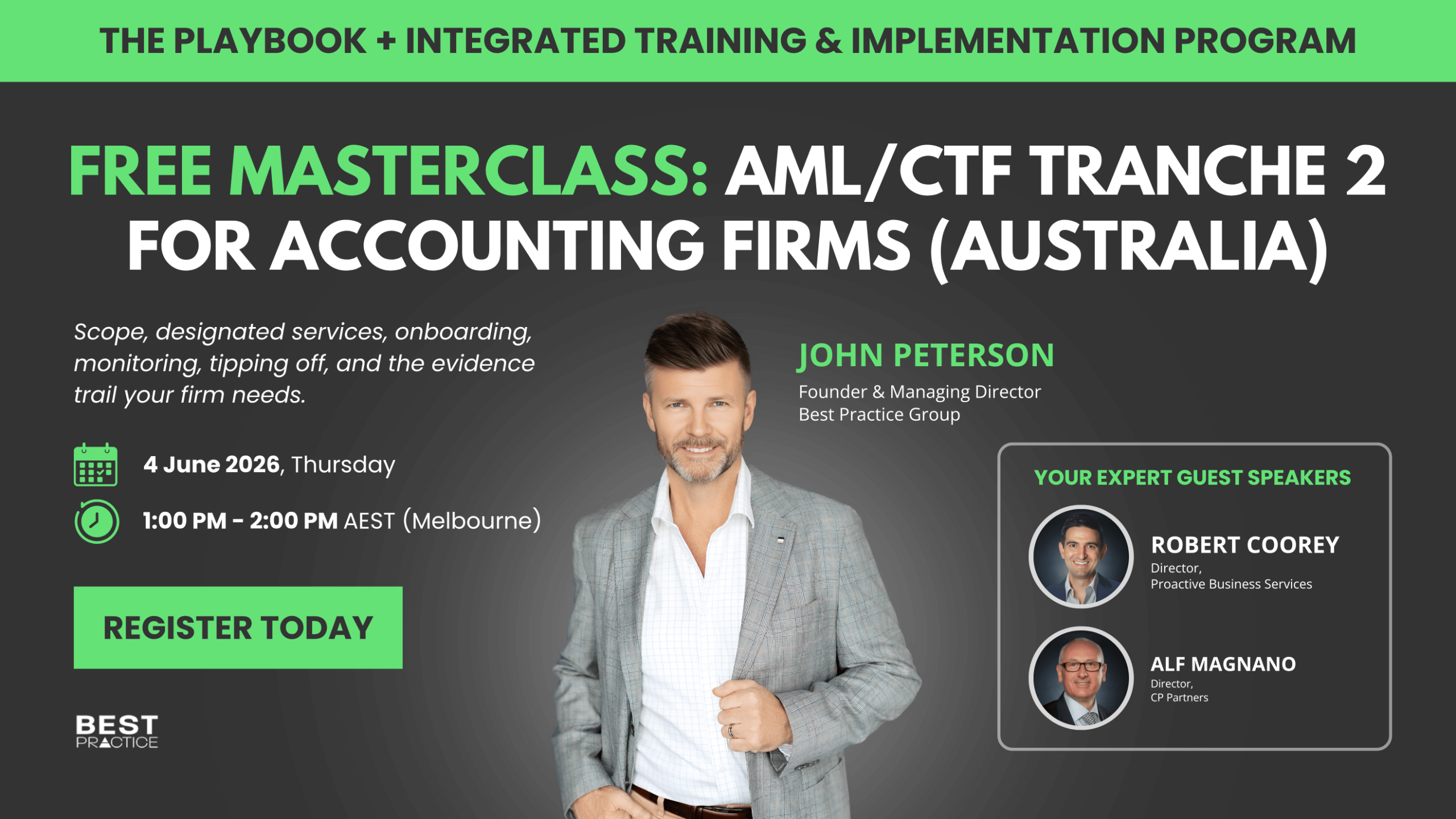
Best Practice Group delivers a turnkey AML/CTF Tranche 2 Training and Certification Program designed specifically for public accounting firms. It includes a complete compliance playbook, two live implementation sessions across three rounds in May, June, and July, 16 operational templates, mandatory compliance assessments, and two certificates per participant issued by Best Practice Group.
If your firm needs to get operational before 1 July 2026, the time to enrol is now.
👉 Register for the AML/CTF Tranche 2 Training Program
👉 Get the AML Playbook
Or contact us directly:
📧 [email protected]
📞 1300 274 636
This article is general guidance only and does not constitute legal advice. Firms should confirm their specific obligations under the Anti-Money Laundering and Counter-Terrorism Financing Act 2006 (Cth) and seek independent legal advice where required.